

A Note on the Silent Decline of the Caspian Environment
By: Hamid A.K. Lahijani a, Peygham Ghaffari b, Suzanne A.G. Leroy c d, Abdolmajid Naderi Beni a, Evgeniy V. Yakushev e f, Behrooz Abtahi g, Abolfazl Saleh a, Milad Behravesh a
By: Hamid A.K. Lahijani a, Peygham Ghaffari b, Suzanne A.G. Leroy c d, Abdolmajid Naderi Beni a, Evgeniy V. Yakushev e f, Behrooz Abtahi g, Abolfazl Saleh a, Milad Behravesh a
Highlights
- Main challenges of the Caspian Sea (physical alteration, pollution and climate change) are introduced.
- Long-term impact of the human intervention led to the decline of bioresources.
- A systematic approach to the Caspian environment is required to highlight the key factors for restoration
Link to original publication.
Abstract
The Caspian Sea, the world's largest enclosed water body, experiences significant transformations in its physico-chemical properties and a decline in bioresources due to extensive anthropogenic activities. These activities include the discharge of diverse pollutants and bio-physical alterations such as over-fishing, hunting, and physical alterations to rivers. While acute manifestations such as a fall in the Caspian water levels and wetland desiccation are more overt, the pervasive impact of human activities contributes to a likely irreversible decline in environmental quality that we aim to spotlight in this discussion in order to facilitate its restoration.
Introduction
The Caspian Sea being the world's largest closed water body benefits surrounding nations and beyond by its natural resources, ecosystem services, and climate modifications. Currently, the Caspian Sea is struggling with tremendous challenges imposed by human intervention through physical alterations, pollutions which are exacerbated by the impact of climate change leading to drastic environmental degradation. Human activities of eight countries (Russia, Azerbaijan Republic, Iran, Turkmenistan, Kazakhstan, Armenia, Georgia and Turkey) in the catchment basin, five of the formers border the Caspian shores, impact the Caspian ecosystem.
Intensive human activity in the Caspian region began with industrial oil exploitation in the late 18th century in Baku (Craig et al., 2018). This led to increased hydrocarbon seepage into the sea due to industrial-scale activities (Tarasov, 1996). The period from 1950 to 1980 saw heightened urbanization, construction of hydraulic structures, and expansion of agricultural fields (Akhmadiyeva and Abdullaev, 2019). Following the dissolution of the Soviet Union in 1991, stakeholders intensified resource exploitation, pollution discharge, and alteration of river hydrology in the Caspian catchment (Barannik et al., 2004).
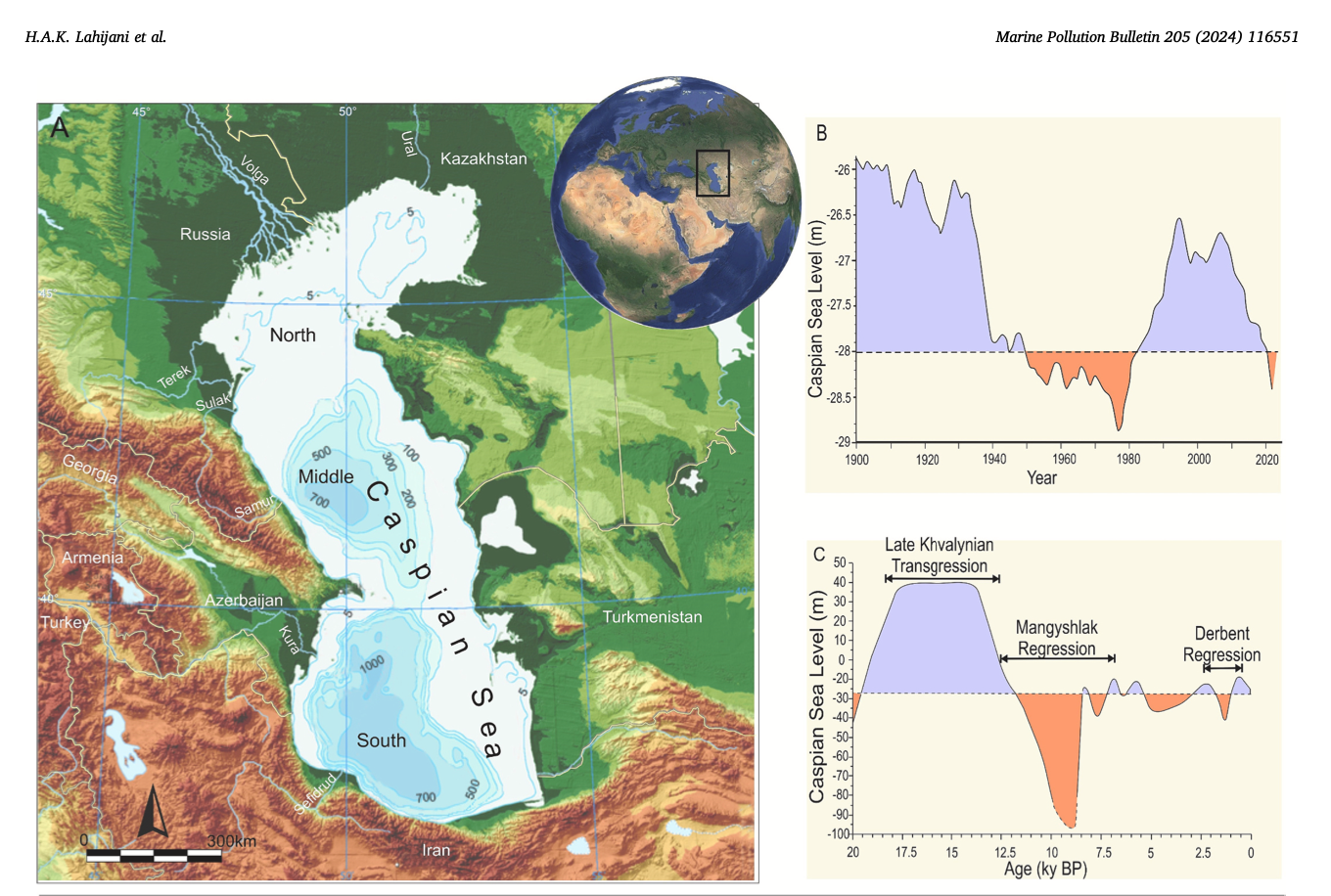
The impact of climate change in the Caspian Sea is manifested by higher air and surface water temperatures and a drop in the sea level (Molavi-Arabshahi et al., 2016; Kashkooli et al., 2019; Ginzburg et al., 2021). Throughout instrumental measurement period, the Caspian Sea has undergone fluctuations in sea level, with fluctuations of approximately 3 m recorded (Lahijani et al., 2023) (Fig. 1B). However, the early Holocene witnessed a more significant decrease in sea level, as evidenced by geological and historical data (Koriche et al., 2022; Tudryn et al., 2022). Despite these fluctuations, current trends suggest that the sea is far from desiccation (Fig. 1C), indicating ongoing stability in its hydrological regime.
Despite efforts by the five Caspian riparian countries to establish institutes with the primary objective of safeguarding the Caspian environment, substantial challenges yet persist.
This note discusses the observable evidence of environmental degradation in the Caspian region and highlights the perspective for the restoration of the Caspian environment.
The Caspian Sea, the world's largest enclosed water body, experiences significant transformations in its physico-chemical properties and a decline in bioresources due to extensive anthropogenic activities. These activities include the discharge of diverse pollutants and bio-physical alterations such as over-fishing, hunting, and physical alterations to rivers. While acute manifestations such as a fall in the Caspian water levels and wetland desiccation are more overt, the pervasive impact of human activities contributes to a likely irreversible decline in environmental quality that we aim to spotlight in this discussion in order to facilitate its restoration.
Introduction
The Caspian Sea being the world's largest closed water body benefits surrounding nations and beyond by its natural resources, ecosystem services, and climate modifications. Currently, the Caspian Sea is struggling with tremendous challenges imposed by human intervention through physical alterations, pollutions which are exacerbated by the impact of climate change leading to drastic environmental degradation. Human activities of eight countries (Russia, Azerbaijan Republic, Iran, Turkmenistan, Kazakhstan, Armenia, Georgia and Turkey) in the catchment basin, five of the formers border the Caspian shores, impact the Caspian ecosystem.
Intensive human activity in the Caspian region began with industrial oil exploitation in the late 18th century in Baku (Craig et al., 2018). This led to increased hydrocarbon seepage into the sea due to industrial-scale activities (Tarasov, 1996). The period from 1950 to 1980 saw heightened urbanization, construction of hydraulic structures, and expansion of agricultural fields (Akhmadiyeva and Abdullaev, 2019). Following the dissolution of the Soviet Union in 1991, stakeholders intensified resource exploitation, pollution discharge, and alteration of river hydrology in the Caspian catchment (Barannik et al., 2004).
The impact of climate change in the Caspian Sea is manifested by higher air and surface water temperatures and a drop in the sea level (Molavi-Arabshahi et al., 2016; Kashkooli et al., 2019; Ginzburg et al., 2021). Throughout instrumental measurement period, the Caspian Sea has undergone fluctuations in sea level, with fluctuations of approximately 3 m recorded (Lahijani et al., 2023) (Fig. 1B). However, the early Holocene witnessed a more significant decrease in sea level, as evidenced by geological and historical data (Koriche et al., 2022; Tudryn et al., 2022). Despite these fluctuations, current trends suggest that the sea is far from desiccation (Fig. 1C), indicating ongoing stability in its hydrological regime.
Despite efforts by the five Caspian riparian countries to establish institutes with the primary objective of safeguarding the Caspian environment, substantial challenges yet persist.
This note discusses the observable evidence of environmental degradation in the Caspian region and highlights the perspective for the restoration of the Caspian environment.
2. Bio-physical alteration
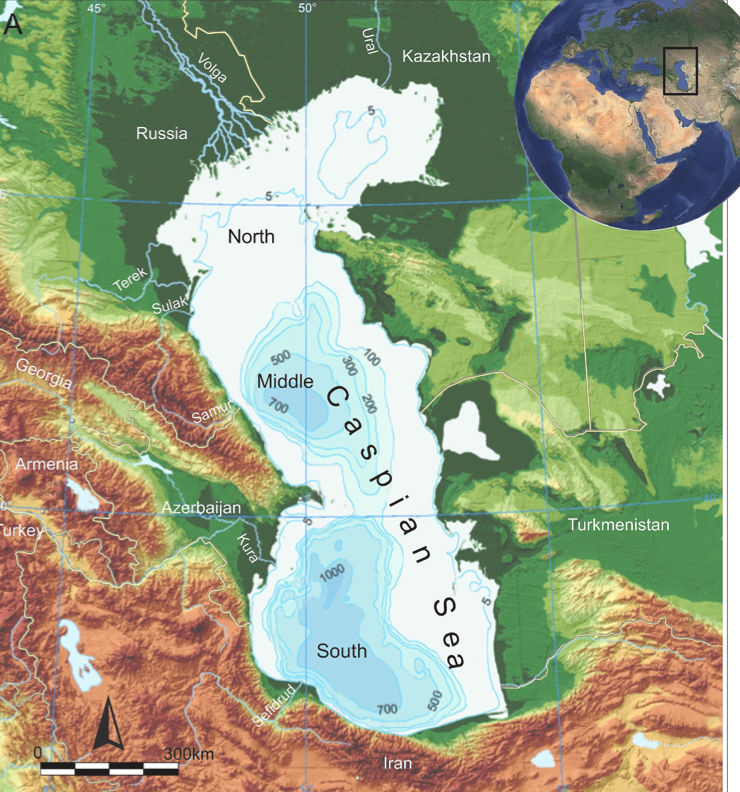
One of the preeminent indicators of anthropogenic influence on the Caspian Sea and its surrounding catchment area (Fig. 1A) is the con- struction of dams and hydraulic infrastructure, intensified during the period from the 1950s to the 1980s in the whole catchment and currently continuing mainly in the southern catchment area (Aliyev, 1994; Akhmadiyeva and Abdullaev, 2019; Lattuada et al., 2019). While these structures facilitated industrial, agricultural, and urban develop- ment in the region, they concurrently induced a significant alteration in the hydrological regime within the Caspian catchment. The imposition of physical barriers across rivers changed the natural riverine influx into the Caspian and disrupted the geo-migratory cycle of native species (Mikhailov, 1997; Lahijani et al., 2008; Khodorevskaya et al., 2014). Given that many Caspian fish reproductions occur in rivers (Kostianoy and Kosarev, 2005), they face challenges such as reduced discharge, physical barriers, and crowded banks due to fishing and tourism activities.
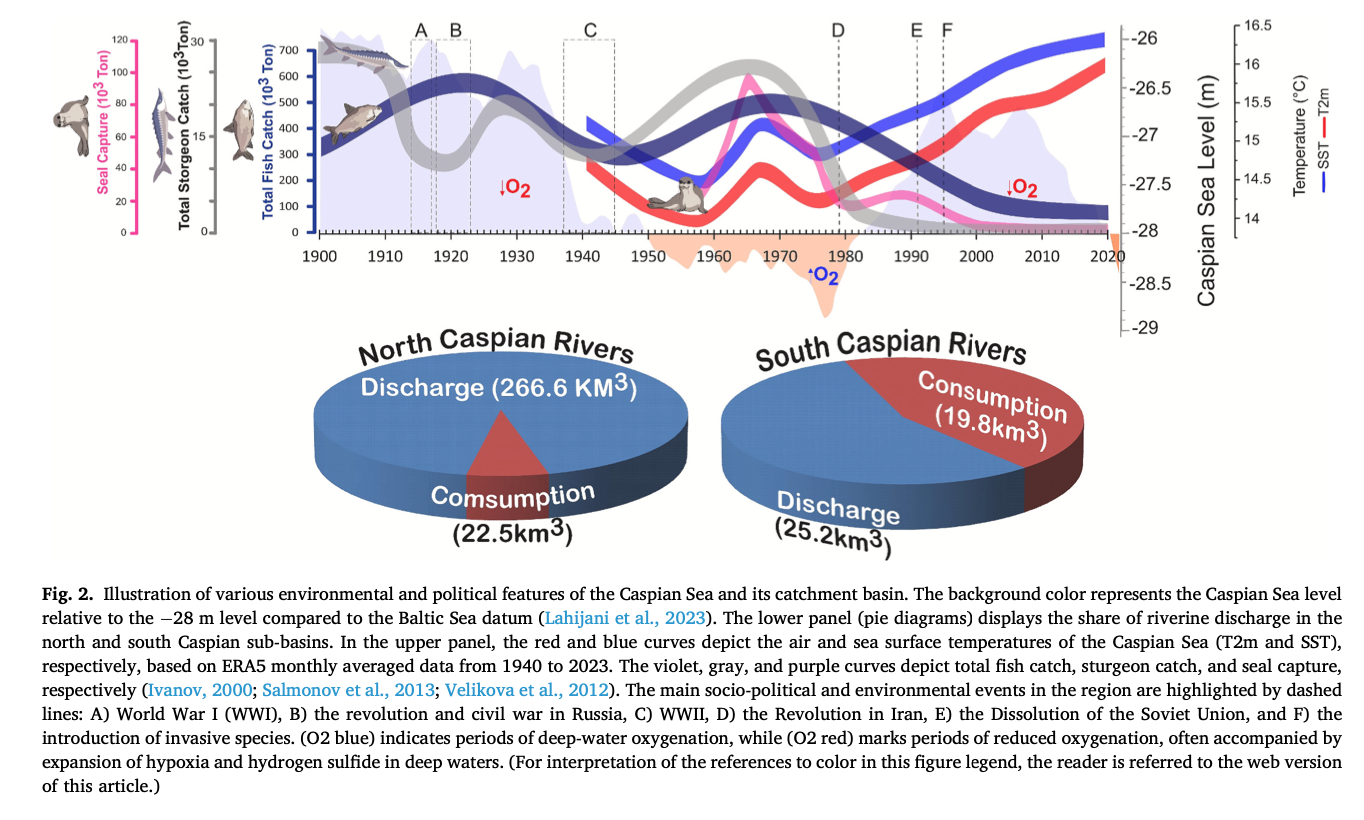
Consequently, the nursery conditions for fish reproduction deterio- rated in most river mouths. While water consumption stabilized in the rivers of the north Caspian, hydraulic mission and water withdrawal in the south Caspian Sea are intensively continuing (Demin, 2007; Akh- madiyeva and Abdullaev, 2019). The Volga River in the north and the Kura River in the south are the largest rivers in the two sub-basins (Fig. 1A). A comparison of water withdrawal in the north and south Caspian sub-basins shows that water consumption is close to the riverine water discharge in the south sub-basin, while in the north, water con- sumption only accounts for around 8 % of the riverine discharge (Fig. 2, lower panel). The overuse of water has changed the hydrological regime, where discharge is below ecological needs in many rivers.
Another noteworthy bio-physical alteration is the widespread occurrence of over-fishing and poaching along the entire Caspian coast. Particularly, the hunting of Caspian Seals (Phoca Caspica) stands out as a pronounced bio-alteration, pushing this unique endemic mammal to the
brink of extinction (Dmitrieva et al., 2013; Strukova et al., 2016). 3. Deoxygenation and pollution
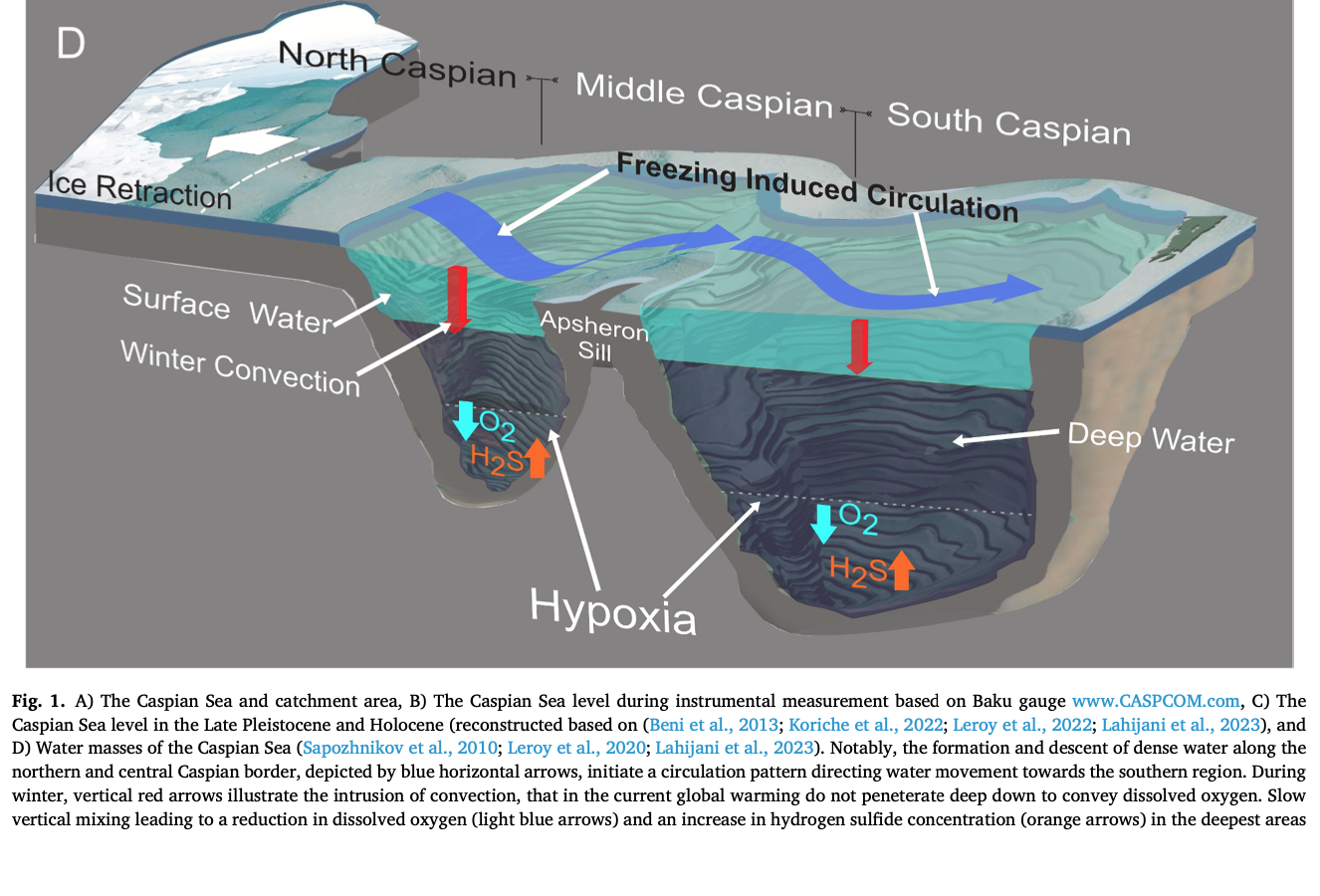
Recent decades have witnessed significant shifts in the hydro- chemistry of the Caspian Sea (Nasrollahzadeh et al., 2008; Sapozhnikov et al., 2010). These changes reflect alterations in nutrient balance and organic matter, linked to dam construction and agricultural expansion. Notably, nitrogen and phosphorus inputs have changed, with carbon- to‐nitrogen ratios indicating decreased ventilation (Saleh et al., 2018). Environmental transformations, including biological invasions and al- terations in nutrient and pollutant inputs, have occurred over the past century (Sapozhnikov et al., 2010; Saleh et al., 2018; Leroy et al., 2020). Freezing episodes in the northern Caspian and winter severity influence deep water mixing, crucial for biogeochemical cycling over the three sub-basins (Tuzhilkin and Kosarev, 2005; Ghaffari et al., 2010). How- ever, warming trends and human activities have led to water column stratification, oxygen depletion, and hypoxia, especially below 400 m depth (Serebrennikova et al., 2015; Torgunova et al., 2020) (Fig. 1D).
Despite the recent profound sea level drop that was expected to be in favor of deeper ventilation, the Caspian’s vertical structure remained unchanged, with persistent hypoxia in deeper layers and significant pollutant accumulation (Dukhova et al., 2015; Torgunova et al., 2020). This stagnant circulation may impact biodiversity and productivity. Furthermore, the Caspian hosts various pollutants, exceeding permis- sible limits and affecting aquatic fauna and human health (De Mora et al., 2004a, 2004b; Tolosa et al., 2004; Kajiwara et al., 2008; Behrooz et al., 2009; Shahbazi et al., 2012; Mehdinia et al., 2020; Abadi et al., 2021).
One of the preeminent indicators of anthropogenic influence on the Caspian Sea and its surrounding catchment area (Fig. 1A) is the con- struction of dams and hydraulic infrastructure, intensified during the period from the 1950s to the 1980s in the whole catchment and currently continuing mainly in the southern catchment area (Aliyev, 1994; Akhmadiyeva and Abdullaev, 2019; Lattuada et al., 2019). While these structures facilitated industrial, agricultural, and urban develop- ment in the region, they concurrently induced a significant alteration in the hydrological regime within the Caspian catchment. The imposition of physical barriers across rivers changed the natural riverine influx into the Caspian and disrupted the geo-migratory cycle of native species (Mikhailov, 1997; Lahijani et al., 2008; Khodorevskaya et al., 2014). Given that many Caspian fish reproductions occur in rivers (Kostianoy and Kosarev, 2005), they face challenges such as reduced discharge, physical barriers, and crowded banks due to fishing and tourism activities.
Consequently, the nursery conditions for fish reproduction deterio- rated in most river mouths. While water consumption stabilized in the rivers of the north Caspian, hydraulic mission and water withdrawal in the south Caspian Sea are intensively continuing (Demin, 2007; Akh- madiyeva and Abdullaev, 2019). The Volga River in the north and the Kura River in the south are the largest rivers in the two sub-basins (Fig. 1A). A comparison of water withdrawal in the north and south Caspian sub-basins shows that water consumption is close to the riverine water discharge in the south sub-basin, while in the north, water con- sumption only accounts for around 8 % of the riverine discharge (Fig. 2, lower panel). The overuse of water has changed the hydrological regime, where discharge is below ecological needs in many rivers.
Another noteworthy bio-physical alteration is the widespread occurrence of over-fishing and poaching along the entire Caspian coast. Particularly, the hunting of Caspian Seals (Phoca Caspica) stands out as a pronounced bio-alteration, pushing this unique endemic mammal to the
brink of extinction (Dmitrieva et al., 2013; Strukova et al., 2016). 3. Deoxygenation and pollution
Recent decades have witnessed significant shifts in the hydro- chemistry of the Caspian Sea (Nasrollahzadeh et al., 2008; Sapozhnikov et al., 2010). These changes reflect alterations in nutrient balance and organic matter, linked to dam construction and agricultural expansion. Notably, nitrogen and phosphorus inputs have changed, with carbon- to‐nitrogen ratios indicating decreased ventilation (Saleh et al., 2018). Environmental transformations, including biological invasions and al- terations in nutrient and pollutant inputs, have occurred over the past century (Sapozhnikov et al., 2010; Saleh et al., 2018; Leroy et al., 2020). Freezing episodes in the northern Caspian and winter severity influence deep water mixing, crucial for biogeochemical cycling over the three sub-basins (Tuzhilkin and Kosarev, 2005; Ghaffari et al., 2010). How- ever, warming trends and human activities have led to water column stratification, oxygen depletion, and hypoxia, especially below 400 m depth (Serebrennikova et al., 2015; Torgunova et al., 2020) (Fig. 1D).
Despite the recent profound sea level drop that was expected to be in favor of deeper ventilation, the Caspian’s vertical structure remained unchanged, with persistent hypoxia in deeper layers and significant pollutant accumulation (Dukhova et al., 2015; Torgunova et al., 2020). This stagnant circulation may impact biodiversity and productivity. Furthermore, the Caspian hosts various pollutants, exceeding permis- sible limits and affecting aquatic fauna and human health (De Mora et al., 2004a, 2004b; Tolosa et al., 2004; Kajiwara et al., 2008; Behrooz et al., 2009; Shahbazi et al., 2012; Mehdinia et al., 2020; Abadi et al., 2021).
4. Climate shifts and sea level variability
Evidence of global warming is discernible through heightened air temperatures in coastal regions and increased temperatures in the upper layer of the Caspian Sea water, as substantiated by crucial studies (Molavi-Arabshahi et al., 2016; Kashkooli et al., 2019; Ginzburg et al., 2021) (Fig. 2) Since 1996, a documented shift in the overall wind regime occurred from meridional to zonal patterns (Arpe et al., 2020; Serykh and Kostianoy, 2020; Vyruchalkina et al., 2020). This alteration in wind patterns has contributed to a further decline in the sea level, as water vapor is exported eastward from the Caspian Sea watershed. Despite numerous attempts to forecast long-term variations in the Caspian Sea level, prediction has proven to be a formidable challenge. Previous at- tempts notably failed to predict the rise in 1978 and the subsequent fall in 1996 (Lahijani et al., 2023). Additionally, it has been demonstrated that global teleconnection indices and macroclimatic drivers exert a significant influence on the sea level variation of the Caspian Sea, particularly during severe depression periods (Azizpour and Ghaffari, 2023). This underscores the intricate interplay of factors influencing the Caspian Sea level, emphasizing the imperative for sustained research efforts to enhance our comprehension and predictive capacities in response to the complexities of the global climate system and its change.
Despite extreme sea level falls that happened in the Caspian Sea in the early Holocene (Koriche et al., 2022; Tudryn et al., 2022) (Fig. 1C), which were deeper than those predicted for the future by Prange et al. (2020) and Samant and Prange (2023) (summarized in Fig. 12 of Lahi- jani et al., 2023), but the Caspian Sea survived although requiring modifications in its geomorphology and its biology. During the past sea level fall with negligible human intervention, the Caspian Sea system recovered by seaward displacement of wetlands and connecting rivers with sufficient discharges to the new shoreline permitting ecological integrity among rivers, coastal wetlands, and the sea itself that is essential for its valuable fish reproductions. Many coastal features, bays, and wetlands have inherited their origin from sea level rise since the mid-Holocene (Lahijani et al., 2009). Despite a tremendous cost to the ecosystem due to a necessary biological adaption (endemism, low biodiversity and bias towards euryhaline species), the Caspian Sea water body is still there. The rise and fall in the sea level happened frequently, neither the last sea-level rise was ecocide (Dumont, 1995) nor the last and current sea-level fall was/is disastrous (Prange et al., 2020) for the Caspian environment.
5. Decline of bioresources
During the Quaternary period, evolutionary processes in Caspian species were influenced by connections to adjacent marine ecosystems (Karpinsky et al., 2005a; Mertens et al., 2017). Large salinity fluctua- tions challenged their survival, yet they adapted to brackish water en- vironments and often endemic species appeared (Leroy et al., 2020). Although the Caspian Sea has lower biodiversity, each species has sig- nificant biomass (Leroy et al., 2020).
Since the early 20th, there has been a dramatic seven-fold decline in annual fish catch, dropping from 700 to less than 100 kt with a shift from sturgeons to bony fish and kilka (Fig. 2). The primary drivers behind this shift include the reduction in the carrying capacity and the scarcity of sturgeon populations within this water body (Khodorevskaya et al., 2014). Artificial reproduction, notably in Iran and Russia, is crucial for sustaining commercial fish stocks amidst environmental changes (Abdolhay, 2004; Sudakova et al., 2018). Sturgeon and Caspian Seal populations have sharply declined, listed as endangered by IUCN (Harkonen et al., 2012). Additionally, introduced species like Mne- miopsis leidyi have disrupted local biodiversity and food webs (Karpinsky et al., 2005b) (Fig. 2).
The Caspian Seal, the sole mammal inhabiting the Caspian Sea, is at the apex of the local food chain and is considered a distinctive endemic species of this ecosystem. The Caspian Seal is an ice-breeding species
Marine Pollution Bulletin 205 (2024) 116551
that tolerates a wide range of temperatures (Kovacs et al., 2018), but requires sea ice for breeding. The Caspian Seal, once over a million strong (Harkonen et al., 2012), now numbers below 170,000 (Dmitrieva et al., 2015; Kydyrmanov et al., 2023), facing diverse threats in its natural habitat (Kydyrmanov et al., 2023).
6. A holistic approach to the Caspian environment and applying best practices
The Caspian Sea is a unique system that links environmental and socioeconomic elements in the circum-region. It provides services and modifies the climate. Previously, coordination of the Caspian Sea was mainly overseen by Iran and Russia/USSR. However, with the emer- gence of three new stakeholders in 1991 (Fig. 2), the legal dimensions of Caspian Sea management, including environmental considerations, have grown more intricate. Intensive usage of the Caspian resources since 1991 surpassed its capacity. It concurred with the disruption in scientific practices that accumulated the most Caspian data during 1960–1990 (Tuzhilkin and Kosarev, 2005; Lahijani et al., 2023). Many studies are devoted to the Caspian Sea highlighting different aspects of its environment, only a few of which systematically look at interactions among the different components incorporated into the Caspian envi- ronment. Current studies mostly advocate a detailed framework of a specific topic rather than integrating governing elements and processes as those experienced in the oceans (Asmus et al., 2021). Moreover, Caspian data gathering experienced a significant decline during the past three decades. Despite extensive scientific findings and outreach activ- ities using remotely sensed and reanalysis data and simulations, still in situ measurement and sampling are required for a correct assessment of the state of the Caspian environment. The practices that are applied in the marine environment for monitoring, data processing, and applica- tion can be adapted for the Caspian Sea as the best practices (Pearlman, 2019). Application of the best practices to observe the whole Caspian system provides a knowledge backbone for supporting decisions on the Caspian sustainability. The hiatus between the Caspian science and Caspian health is the sluggish steps that the rim countries moving to- wards a knowledge-based decision and the bigger time lag for accom- plishing it.
7. Conclusion
While the Caspian Sea has experienced significant natural changes in the past, the current environmental challenges pose a greater threat due to the increased population and infrastructure dependency. The unsus- tainable usage of riverine water resources, marine bioresources, pollu- tion, and climate change are key factors contributing to these challenges. Overfishing, hunting, and habitat destruction have led to a decline in the Caspian bioresources, while pollution and climate change have exacerbated marine environmental degradation.
Without prompt intervention, efforts to address the Caspian envi- ronmental issues risk stalling in previous negotiations. The upcoming COP 29 in Baku presents a crucial opportunity to raise global awareness of the Caspian issues. Additionally, the ongoing UN Decade on Ecosystem Restoration offers a timely platform for the Caspian countries to prioritize actionable steps for environmental enhancement. These may include enforcing bans on sturgeon and seal harvesting, designating protected areas for natural fish reproduction, and implementing stra- tegies to reduce pollution.
Investing in such fundamental mitigation measures could yield sig- nificant improvements in the ecosystem services and promote sustain- able resource management in the Caspian region. Moreover, expanding monitoring and research using world best practices are essential to assess the state of the environment and effectiveness of environmental restoration actions and their long-term impacts.
By taking decisive action and implementing sustainable practices, the Caspian countries can safeguard the future of this unique and
4
H.A.K. Lahijani et al.
invaluable ecosystem for generations to come.
CRediT authorship contribution statement
Hamid A.K. Lahijani: Writing – review & editing, Writing – original draft, Visualization, Supervision, Resources, Methodology, Investiga- tion, Data curation, Conceptualization. Peygham Ghaffari: Writing – review & editing, Writing – original draft, Supervision, Investigation, Conceptualization. Suzanne A.G. Leroy: Writing – review & editing. Abdolmajid Naderi Beni: Writing – review & editing, Visualization, Data curation. Evgeniy V. Yakushev: Writing – review & editing. Behrooz Abtahi: Writing – review & editing. Abolfazl Saleh: Writing – review & editing. Milad Behravesh: Writing – review & editing, Formal analysis, Data curation.
Declaration of competing interest
The authors declare no competing interests.
Data availability
The most data used here are available internationaly.
Acknowledgement
This research was partially supported by the Iranian National Insti- tute for Oceanography and Atmospheric Science, research project number INIOAS-1400-012-01-02-01. Also, partial support was received through INSF-4012973 project and CRIPTIC project, which was funded by the Norwegian Retailers’ Environment Fund. We are grateful to the journal Chief Editor Prof. Francois Galgani and the unanimous reviewer for the constructive comments and suggestions for improving the manuscript.
References
Abadi, Z.T.R., Abtahi, B., Grossart, H.-P., Khodabandeh, S., 2021. Microplastic content of Kutum fish, Rutilus frisii kutum in the southern Caspian Sea. Sci. Total Environ. 752, 141542.
Abdolhay, H., 2004. Sturgeon stocking programme. FAO Fish. Tech. Pap. 429, 133. Akhmadiyeva, Z., Abdullaev, I., 2019. Water management paradigm shifts in the Caspian
Sea region: review and outlook. J. Hydrol. 568, 997–1006.
Aliyev, N., 1994. The history of oil in Azerbaijan. Azerbaijan International 2 (2), 22–23. Arpe, K., Molavi-Arabshahi, M., Leroy, S.A.G., 2020. Wind variability over the Caspian
Sea, its impact on Caspian seawater level and link with ENSO. Int. J. Climatol. 40
(14), 6039–6054.
Asmus, M.L., et al., 2021. Systems approach: a shortcut to the ocean we want. Ocean and
Coastal Research v69 (suppl), e21042. https://doi.org/10.1590/2675-
2824069.21023mla.
Azizpour, J., Ghaffari, P., 2023. Low-frequency sea level changes in the Caspian Sea:
long-term and seasonal trends. Clim. Dyn. 61 (5), 2753–2763.
Barannik, V., Borysova, O., Stolberg, F., 2004. The Caspian Sea region: environmental
change. AMBIO: A Journal of the Human Environment 33 (1), 45–51. Behrooz, R.D., Sari, A.E., Bahramifar, N., Ghasempouri, S., 2009. Organochlorine
pesticide and polychlorinated biphenyl residues in human milk from the Southern
Coast of Caspian Sea, Iran. Chemosphere 74 (7), 931–937.
Beni, A.N., Lahijani, H., Harami, R.M., Arpe, K., Leroy, S., Marriner, N., Berberian, M.,
Andrieu-Ponel, V., Djamali, M., Mahboubi, A., 2013. Caspian sea level changes during the last millennium: historical and geological evidences from the south Caspian Sea. Clim. Past 9 (4), 1645–1665.
Craig, J., Gerali, F., MacAulay, F., Sorkhabi, R., 2018. The history of the European oil and gas industry (1600s–2000s). The Geological Society of London London v, 1.
De Mora, S., Sheikholeslami, M.R., Wyse, E., Azemard, S., Cassi, R., 2004a. An assessment of metal contamination in coastal sediments of the Caspian Sea. Mar. Pollut. Bull. 48 (1), 61–77.
De Mora, S., Villeneuve, J.-P., Sheikholeslami, M.R., Cattini, C., Tolosa, I., 2004b. Organochlorinated compounds in Caspian Sea sediments. Mar. Pollut. Bull. 48 (1–2), 30–43.
Demin, A., 2007. Present-day changes in water consumption in the Caspian Sea basin. Water Res. 34, 237–253.
Dmitrieva, L., Kondakov, A.A., Oleynikov, E., Kydyrmanov, A., Karamendin, K., Kasimbekov, Y., Baimukanov, M., Wilson, S., Goodman, S.J., 2013. Assessment of Caspian seal by-catch in an illegal fishery using an interview-based approach. PLoS One 8 (6), e67074.
Marine Pollution Bulletin 205 (2024) 116551
Dmitrieva, L., H ̈arko ̈nen, T., Baimukanov, M., Bignert, A., Jüssi, I., Jüssi, M., Kasimbekov, Y., Verevkin, M., Vysotskiy, V., Wilson, S., 2015. Inter-year variation in pup production of Caspian seals Pusa caspica 2005 2012 determined from aerial surveys. Endanger. Species Res. 28 (3), 209–223.
Dukhova, L., Serebrennikova, E., Ambrosimov, A., Klyuvitkin, A., 2015. Hydrochemical studies of deep-water basins of the Caspian Sea in August–September 2013 aboard the R/V Nikifor Shurekov. Oceanology 55, 145–147.
Dumont, H., 1995. Ecocide in the Caspian Sea. Nature 377, 673–674. https://doi.org/ 10.1038/377673a0.
Ghaffari, P., Lahijani, H., Azizpour, J., 2010. Snapshot observation of the physical structure and stratification in deep-water of the South Caspian Sea (western part). Ocean Sci. 6 (4), 877–885.
Ginzburg, A., Kostianoy, A., Serykh, I., Lebedev, S., 2021. Climatic changes in hydrometeorological parameters of the Caspian Sea (1980–2020). Sovremennye problemy distantsionnogo zondirovaniya Zemli iz kosmosa 18 (5), 277–291.
Harkonen, T., Harding, K.C., Wilson, S., Baimukanov, M., Dmitrieva, L., Svensson, C.J., Goodman, S.J., 2012. Collapse of a Marine Mammal Species Driven by Human Impacts.
Ivanov, V.P., 2000. Biological Resources of the Caspian Sea. Astrakhan, KaspNIRKH. Kajiwara, N., Watanabe, M., Wilson, S., Eybatov, T., Mitrofanov, I.V., Aubrey, D.G.,
Khuraskin, L.S., Miyazaki, N., Tanabe, S., 2008. Persistent organic pollutants (POPs) in Caspian seals of unusual mortality event during 2000 and 2001. Environ. Pollut. 152 (2), 431–442.
Karpinsky, M.G., Katunin, D.N., Goryunova, V.B., Shiganova, T.A., 2005a. Biological Features and Resources: The Caspian Sea Environment, pp. 191–210.
Karpinsky, M.G., Shiganova, T.A., Katunin, D.N., 2005b. Introduced Species: The Caspian Sea Environment, pp. 175–190.
Kashkooli, O.B., Ghadami, M., Amini, M., Modarres, R., 2019. Spatiotemporal variation of the southern Caspian Sea surface temperature during 1982–2016. J. Mar. Syst. 193, 126–136.
Khodorevskaya, R., Kim, Y., Shahifar, R., Mammadov, E., Katunin, D., Morozov, B., Akhundov, M., Muradov, O., Velikova, V., 2014. State and Dynamics of the Bioresources in the Caspian Sea. Springer.
Koriche, S.A., Singarayer, J.S., Cloke, H.L., Valdes, P.J., Wesselingh, F.P.,
Kroonenberg, S.B., Wickert, A.D., Yanina, T.A., 2022. What are the drivers of Caspian Sea level variation during the late Quaternary? Quat. Sci. Rev. 283, 107457.
Kostianoy, A.G., Kosarev, A.N., 2005. The Caspian Sea Environment. Springer Science & Business Media.
Kovacs, K.M., Thewissen, J., Würsig, B.G., 2018. In: Würsig, Bernd, Thewissen, J.G.M., Kovacs, Kit M. (Eds.), Encyclopedia of Marine Mammals. Academic Press.
Kydyrmanov, A., Karamendin, K., Kassymbekov, Y., Kumar, M., Mazkirat, S., Suleimenova, S., Baimukanov, M., Carr, I.M., Goodman, S.J., 2023. Exposure of wild Caspian seals (Pusa caspica) to parasites, bacterial and viral pathogens, evaluated via molecular and serological assays. Front. Mar. Sci. 10, 1087997.
Lahijani, H., Tavakoli, V., Amini, A., 2008. River mouth configuration in south Caspian coast, Iran. Environ. Sci. 5 (2), 65–86.
Lahijani, H., Rahimpour-Bonab, H., Tavakoli, V., Hosseindoost, M., 2009. Evidence for late Holocene highstands in Central Guilan- East Mazanderan, South Caspian coast, Iran. Quarter. Inter. 197, 55–71.
Lahijani, H., Leroy, S., Arpe, K., Cretaux, J.-F., 2023. Caspian Sea level changes during instrumental period, its impact and forecast: a review. Earth Sci. Rev. 241, 104428.
Lattuada, M., Albrecht, C., Wilke, T., 2019. Differential impact of anthropogenic pressures on Caspian Sea ecoregions. Mar. Pollut. Bull. 142, 274–281.
Leroy, S.A., Lahijani, H.A., Cr ́etaux, J.-F., Aladin, N.V., Plotnikov, I.S., 2020. Past and current changes in the largest lake of the world: the Caspian Sea: Large asian lakes in a changing world. Natural State and Human Impact 65–107.
Leroy, S.A., Reimer, P.J., Lahijani, H., Beni, A.N., Sauer, E., Chali ́e, F., Arpe, K., Demory, F., Mertens, K., Belkacem, D., 2022. Caspian Sea levels over the last 2200 years, with new data from the SE corner. Geomorphology 403, 108136.
Mehdinia, A., Dehbandi, R., Hamzehpour, A., Rahnama, R., 2020. Identification of microplastics in the sediments of southern coasts of the Caspian Sea, north of Iran. Environ. Pollut. 258, 113738.
Mertens, K.N., Takano, Y., Gu, H., Bagheri, S., Pospelova, V., Pien ́kowski, A.J., Leroy, S. A., Matsuoka, K., 2017. Cyst-Theca relationship and phylogenetic position of Impagidinium caspienense incubated from Caspian Sea surface sediments: relation to Gonyaulax baltica and evidence for heterospory within gonyaulacoid dinoflagellates. J. Eukaryot. Microbiol. 64 (6), 829–842.
Mikhailov, V., 1997. River mouths of Russia and adjacent countries: past, present and future: GEOS. Moscow 413.
Molavi-Arabshahi, M., Arpe, K., Leroy, S., 2016. Precipitation and temperature of the Southwest Caspian Sea region during the last 55 years: their trends and teleconnections with large-scale atmospheric phenomena. Int. J. Climatol. 36 (5), 2156–2172.
Nasrollahzadeh, H.S., Din, Z.B., Foong, S.Y., Makhlough, A., 2008. Trophic status of the Iranian Caspian Sea based on water quality parameters and phytoplankton diversity. Cont. Shelf Res. 28 (9), 1153–1165.
Pearlman, J., 2019. Evolving and sustaining ocean best practices and standards for the next decade. Front. Mar. Sci. 6, 277. https://doi.org/10.3389/fmars.2019.00277.
Prange, M., Wilke, T., Wesselingh, F.P., 2020. The other side of sea level change. Communications Earth & Environment 1 (1), 69.
Saleh, A., Hamzehpour, A., Mehdinia, A., Bastami, K.D., Mazaheri, S., 2018. Hydrochemistry and nutrient distribution in southern deep-water basin of the Caspian Sea. Mar. Pollut. Bull. 127, 406–411.
Salmonov, Z., Qasimov, A., Fersoy, H., van Anrooy, R., 2013. Fisheries and aquaculture in the republic of Azerbaijan: a review. FAO Fisheries and Aquaculture Circular C1030/4, I.
5
H.A.K. Lahijani et al.
Samant, R., Prange, M., 2023. Climate-driven 21st century Caspian Sea level decline estimated from CMIP6 projections. Communications Earth & Environment 4 (1), 357.
Sapozhnikov, V., Mordasova, N., Metreveli, M., 2010. Transformations in the Caspian Sea ecosystem under the fall and rise of the sea level. Oceanology 50 (4), 488–497.
Serebrennikova, E., Sapozhnikov, V., Dukhova, L., 2015. Special features of the hydrochemical conditions variability in the deep water basins of the Caspian Sea. Oceanology 55, 194–199.
Serykh, I., Kostianoy, A., 2020. The links of climate change in the Caspian Sea to the Atlantic and Pacific Oceans. Russ. Meteorol. Hydrol. 45, 430–437.
Shahbazi, A., Bahramifar, N., Smolders, E., 2012. Elevated concentrations of pesticides and PCBs in soils at the Southern Caspian Sea (Iran) are related to land use. Soil and Sediment Contamination: An Int. J. 21 (2), 160–175.
Strukova, E., Guchgeldiyev, O., Evans, A., Katunin, D., Khodorevskaya, R., Kim, Y., Akhundov, M., Mammadli, T., Shahivar, R., Muradov, O., 2016. Exploitation of the Caspian Sea Bioresources (With Focus on Economics of Bioresources Utilization). Springer.
Sudakova, N., Mikodina, E., Vasilyeva, L., 2018. Sturgeon (Acipenseridae) artificial reproduction paradigm changeover under conditions of natural stock deficit of sturgeon in the Volga-Caspian Basin. Sel’skokhozyaĭstvennaya Biologiya 53 (4), 698–711.
Marine Pollution Bulletin 205 (2024) 116551
Tarasov, A., 1996. Biological consequences of pollution of the Caspian Sea basin (prior to 1917). Water Res. 23 (4), 416–425.
Tolosa, I., de Mora, S., Sheikholeslami, M.R., Villeneuve, J.-P., Bartocci, J., Cattini, C., 2004. Aliphatic and aromatic hydrocarbons in coastal Caspian Sea sediments. Mar. Pollut. Bull. 48 (1–2), 44–60.
Torgunova, N., Arzhanova, N., Hursanov, A., L’vova, O., 2020. Hydrology- hydrochemical researches of the Caspian Sea in July-August 2019. Expeditions 180 (2).
Tudryn, A., Gibert-Brunet, E., Tucholka, P., Antipov, M.P., Leroy, S.A., 2022. Chronology of the Late Pleistocene Caspian Sea hydrologic changes: a review of dates and proposed climate-induced driving mechanisms. Quat. Sci. Rev. 293, 107672.
Tuzhilkin, V.S., Kosarev, A.N., 2005. Thermohaline Structure and General Circulation of the Caspian Sea Waters: The Caspian Sea Environment, pp. 33–57.
Velikova, V., Shaudanov, A., Gasimov, A., Korshenko, A., Abdoli, A., Morozov, B., Katunin, D., Mammadov, E., Bokova, E., Emadi, H., 2012. Review of the Environment and Bioresources in the Caspian Sea Ecosystem 2000–2010: CaspEco Report, 423.
Vyruchalkina, T.Y., Dianskii, N., Fomin, V., 2020. Effect of long-term variations in wind regime over Caspian Sea Region on the evolution of its level in 1948–2017. Water Res. 47, 348–357.
Evidence of global warming is discernible through heightened air temperatures in coastal regions and increased temperatures in the upper layer of the Caspian Sea water, as substantiated by crucial studies (Molavi-Arabshahi et al., 2016; Kashkooli et al., 2019; Ginzburg et al., 2021) (Fig. 2) Since 1996, a documented shift in the overall wind regime occurred from meridional to zonal patterns (Arpe et al., 2020; Serykh and Kostianoy, 2020; Vyruchalkina et al., 2020). This alteration in wind patterns has contributed to a further decline in the sea level, as water vapor is exported eastward from the Caspian Sea watershed. Despite numerous attempts to forecast long-term variations in the Caspian Sea level, prediction has proven to be a formidable challenge. Previous at- tempts notably failed to predict the rise in 1978 and the subsequent fall in 1996 (Lahijani et al., 2023). Additionally, it has been demonstrated that global teleconnection indices and macroclimatic drivers exert a significant influence on the sea level variation of the Caspian Sea, particularly during severe depression periods (Azizpour and Ghaffari, 2023). This underscores the intricate interplay of factors influencing the Caspian Sea level, emphasizing the imperative for sustained research efforts to enhance our comprehension and predictive capacities in response to the complexities of the global climate system and its change.
Despite extreme sea level falls that happened in the Caspian Sea in the early Holocene (Koriche et al., 2022; Tudryn et al., 2022) (Fig. 1C), which were deeper than those predicted for the future by Prange et al. (2020) and Samant and Prange (2023) (summarized in Fig. 12 of Lahi- jani et al., 2023), but the Caspian Sea survived although requiring modifications in its geomorphology and its biology. During the past sea level fall with negligible human intervention, the Caspian Sea system recovered by seaward displacement of wetlands and connecting rivers with sufficient discharges to the new shoreline permitting ecological integrity among rivers, coastal wetlands, and the sea itself that is essential for its valuable fish reproductions. Many coastal features, bays, and wetlands have inherited their origin from sea level rise since the mid-Holocene (Lahijani et al., 2009). Despite a tremendous cost to the ecosystem due to a necessary biological adaption (endemism, low biodiversity and bias towards euryhaline species), the Caspian Sea water body is still there. The rise and fall in the sea level happened frequently, neither the last sea-level rise was ecocide (Dumont, 1995) nor the last and current sea-level fall was/is disastrous (Prange et al., 2020) for the Caspian environment.
5. Decline of bioresources
During the Quaternary period, evolutionary processes in Caspian species were influenced by connections to adjacent marine ecosystems (Karpinsky et al., 2005a; Mertens et al., 2017). Large salinity fluctua- tions challenged their survival, yet they adapted to brackish water en- vironments and often endemic species appeared (Leroy et al., 2020). Although the Caspian Sea has lower biodiversity, each species has sig- nificant biomass (Leroy et al., 2020).
Since the early 20th, there has been a dramatic seven-fold decline in annual fish catch, dropping from 700 to less than 100 kt with a shift from sturgeons to bony fish and kilka (Fig. 2). The primary drivers behind this shift include the reduction in the carrying capacity and the scarcity of sturgeon populations within this water body (Khodorevskaya et al., 2014). Artificial reproduction, notably in Iran and Russia, is crucial for sustaining commercial fish stocks amidst environmental changes (Abdolhay, 2004; Sudakova et al., 2018). Sturgeon and Caspian Seal populations have sharply declined, listed as endangered by IUCN (Harkonen et al., 2012). Additionally, introduced species like Mne- miopsis leidyi have disrupted local biodiversity and food webs (Karpinsky et al., 2005b) (Fig. 2).
The Caspian Seal, the sole mammal inhabiting the Caspian Sea, is at the apex of the local food chain and is considered a distinctive endemic species of this ecosystem. The Caspian Seal is an ice-breeding species
Marine Pollution Bulletin 205 (2024) 116551
that tolerates a wide range of temperatures (Kovacs et al., 2018), but requires sea ice for breeding. The Caspian Seal, once over a million strong (Harkonen et al., 2012), now numbers below 170,000 (Dmitrieva et al., 2015; Kydyrmanov et al., 2023), facing diverse threats in its natural habitat (Kydyrmanov et al., 2023).
6. A holistic approach to the Caspian environment and applying best practices
The Caspian Sea is a unique system that links environmental and socioeconomic elements in the circum-region. It provides services and modifies the climate. Previously, coordination of the Caspian Sea was mainly overseen by Iran and Russia/USSR. However, with the emer- gence of three new stakeholders in 1991 (Fig. 2), the legal dimensions of Caspian Sea management, including environmental considerations, have grown more intricate. Intensive usage of the Caspian resources since 1991 surpassed its capacity. It concurred with the disruption in scientific practices that accumulated the most Caspian data during 1960–1990 (Tuzhilkin and Kosarev, 2005; Lahijani et al., 2023). Many studies are devoted to the Caspian Sea highlighting different aspects of its environment, only a few of which systematically look at interactions among the different components incorporated into the Caspian envi- ronment. Current studies mostly advocate a detailed framework of a specific topic rather than integrating governing elements and processes as those experienced in the oceans (Asmus et al., 2021). Moreover, Caspian data gathering experienced a significant decline during the past three decades. Despite extensive scientific findings and outreach activ- ities using remotely sensed and reanalysis data and simulations, still in situ measurement and sampling are required for a correct assessment of the state of the Caspian environment. The practices that are applied in the marine environment for monitoring, data processing, and applica- tion can be adapted for the Caspian Sea as the best practices (Pearlman, 2019). Application of the best practices to observe the whole Caspian system provides a knowledge backbone for supporting decisions on the Caspian sustainability. The hiatus between the Caspian science and Caspian health is the sluggish steps that the rim countries moving to- wards a knowledge-based decision and the bigger time lag for accom- plishing it.
7. Conclusion
While the Caspian Sea has experienced significant natural changes in the past, the current environmental challenges pose a greater threat due to the increased population and infrastructure dependency. The unsus- tainable usage of riverine water resources, marine bioresources, pollu- tion, and climate change are key factors contributing to these challenges. Overfishing, hunting, and habitat destruction have led to a decline in the Caspian bioresources, while pollution and climate change have exacerbated marine environmental degradation.
Without prompt intervention, efforts to address the Caspian envi- ronmental issues risk stalling in previous negotiations. The upcoming COP 29 in Baku presents a crucial opportunity to raise global awareness of the Caspian issues. Additionally, the ongoing UN Decade on Ecosystem Restoration offers a timely platform for the Caspian countries to prioritize actionable steps for environmental enhancement. These may include enforcing bans on sturgeon and seal harvesting, designating protected areas for natural fish reproduction, and implementing stra- tegies to reduce pollution.
Investing in such fundamental mitigation measures could yield sig- nificant improvements in the ecosystem services and promote sustain- able resource management in the Caspian region. Moreover, expanding monitoring and research using world best practices are essential to assess the state of the environment and effectiveness of environmental restoration actions and their long-term impacts.
By taking decisive action and implementing sustainable practices, the Caspian countries can safeguard the future of this unique and
4
H.A.K. Lahijani et al.
invaluable ecosystem for generations to come.
CRediT authorship contribution statement
Hamid A.K. Lahijani: Writing – review & editing, Writing – original draft, Visualization, Supervision, Resources, Methodology, Investiga- tion, Data curation, Conceptualization. Peygham Ghaffari: Writing – review & editing, Writing – original draft, Supervision, Investigation, Conceptualization. Suzanne A.G. Leroy: Writing – review & editing. Abdolmajid Naderi Beni: Writing – review & editing, Visualization, Data curation. Evgeniy V. Yakushev: Writing – review & editing. Behrooz Abtahi: Writing – review & editing. Abolfazl Saleh: Writing – review & editing. Milad Behravesh: Writing – review & editing, Formal analysis, Data curation.
Declaration of competing interest
The authors declare no competing interests.
Data availability
The most data used here are available internationaly.
Acknowledgement
This research was partially supported by the Iranian National Insti- tute for Oceanography and Atmospheric Science, research project number INIOAS-1400-012-01-02-01. Also, partial support was received through INSF-4012973 project and CRIPTIC project, which was funded by the Norwegian Retailers’ Environment Fund. We are grateful to the journal Chief Editor Prof. Francois Galgani and the unanimous reviewer for the constructive comments and suggestions for improving the manuscript.
References
Abadi, Z.T.R., Abtahi, B., Grossart, H.-P., Khodabandeh, S., 2021. Microplastic content of Kutum fish, Rutilus frisii kutum in the southern Caspian Sea. Sci. Total Environ. 752, 141542.
Abdolhay, H., 2004. Sturgeon stocking programme. FAO Fish. Tech. Pap. 429, 133. Akhmadiyeva, Z., Abdullaev, I., 2019. Water management paradigm shifts in the Caspian
Sea region: review and outlook. J. Hydrol. 568, 997–1006.
Aliyev, N., 1994. The history of oil in Azerbaijan. Azerbaijan International 2 (2), 22–23. Arpe, K., Molavi-Arabshahi, M., Leroy, S.A.G., 2020. Wind variability over the Caspian
Sea, its impact on Caspian seawater level and link with ENSO. Int. J. Climatol. 40
(14), 6039–6054.
Asmus, M.L., et al., 2021. Systems approach: a shortcut to the ocean we want. Ocean and
Coastal Research v69 (suppl), e21042. https://doi.org/10.1590/2675-
2824069.21023mla.
Azizpour, J., Ghaffari, P., 2023. Low-frequency sea level changes in the Caspian Sea:
long-term and seasonal trends. Clim. Dyn. 61 (5), 2753–2763.
Barannik, V., Borysova, O., Stolberg, F., 2004. The Caspian Sea region: environmental
change. AMBIO: A Journal of the Human Environment 33 (1), 45–51. Behrooz, R.D., Sari, A.E., Bahramifar, N., Ghasempouri, S., 2009. Organochlorine
pesticide and polychlorinated biphenyl residues in human milk from the Southern
Coast of Caspian Sea, Iran. Chemosphere 74 (7), 931–937.
Beni, A.N., Lahijani, H., Harami, R.M., Arpe, K., Leroy, S., Marriner, N., Berberian, M.,
Andrieu-Ponel, V., Djamali, M., Mahboubi, A., 2013. Caspian sea level changes during the last millennium: historical and geological evidences from the south Caspian Sea. Clim. Past 9 (4), 1645–1665.
Craig, J., Gerali, F., MacAulay, F., Sorkhabi, R., 2018. The history of the European oil and gas industry (1600s–2000s). The Geological Society of London London v, 1.
De Mora, S., Sheikholeslami, M.R., Wyse, E., Azemard, S., Cassi, R., 2004a. An assessment of metal contamination in coastal sediments of the Caspian Sea. Mar. Pollut. Bull. 48 (1), 61–77.
De Mora, S., Villeneuve, J.-P., Sheikholeslami, M.R., Cattini, C., Tolosa, I., 2004b. Organochlorinated compounds in Caspian Sea sediments. Mar. Pollut. Bull. 48 (1–2), 30–43.
Demin, A., 2007. Present-day changes in water consumption in the Caspian Sea basin. Water Res. 34, 237–253.
Dmitrieva, L., Kondakov, A.A., Oleynikov, E., Kydyrmanov, A., Karamendin, K., Kasimbekov, Y., Baimukanov, M., Wilson, S., Goodman, S.J., 2013. Assessment of Caspian seal by-catch in an illegal fishery using an interview-based approach. PLoS One 8 (6), e67074.
Marine Pollution Bulletin 205 (2024) 116551
Dmitrieva, L., H ̈arko ̈nen, T., Baimukanov, M., Bignert, A., Jüssi, I., Jüssi, M., Kasimbekov, Y., Verevkin, M., Vysotskiy, V., Wilson, S., 2015. Inter-year variation in pup production of Caspian seals Pusa caspica 2005 2012 determined from aerial surveys. Endanger. Species Res. 28 (3), 209–223.
Dukhova, L., Serebrennikova, E., Ambrosimov, A., Klyuvitkin, A., 2015. Hydrochemical studies of deep-water basins of the Caspian Sea in August–September 2013 aboard the R/V Nikifor Shurekov. Oceanology 55, 145–147.
Dumont, H., 1995. Ecocide in the Caspian Sea. Nature 377, 673–674. https://doi.org/ 10.1038/377673a0.
Ghaffari, P., Lahijani, H., Azizpour, J., 2010. Snapshot observation of the physical structure and stratification in deep-water of the South Caspian Sea (western part). Ocean Sci. 6 (4), 877–885.
Ginzburg, A., Kostianoy, A., Serykh, I., Lebedev, S., 2021. Climatic changes in hydrometeorological parameters of the Caspian Sea (1980–2020). Sovremennye problemy distantsionnogo zondirovaniya Zemli iz kosmosa 18 (5), 277–291.
Harkonen, T., Harding, K.C., Wilson, S., Baimukanov, M., Dmitrieva, L., Svensson, C.J., Goodman, S.J., 2012. Collapse of a Marine Mammal Species Driven by Human Impacts.
Ivanov, V.P., 2000. Biological Resources of the Caspian Sea. Astrakhan, KaspNIRKH. Kajiwara, N., Watanabe, M., Wilson, S., Eybatov, T., Mitrofanov, I.V., Aubrey, D.G.,
Khuraskin, L.S., Miyazaki, N., Tanabe, S., 2008. Persistent organic pollutants (POPs) in Caspian seals of unusual mortality event during 2000 and 2001. Environ. Pollut. 152 (2), 431–442.
Karpinsky, M.G., Katunin, D.N., Goryunova, V.B., Shiganova, T.A., 2005a. Biological Features and Resources: The Caspian Sea Environment, pp. 191–210.
Karpinsky, M.G., Shiganova, T.A., Katunin, D.N., 2005b. Introduced Species: The Caspian Sea Environment, pp. 175–190.
Kashkooli, O.B., Ghadami, M., Amini, M., Modarres, R., 2019. Spatiotemporal variation of the southern Caspian Sea surface temperature during 1982–2016. J. Mar. Syst. 193, 126–136.
Khodorevskaya, R., Kim, Y., Shahifar, R., Mammadov, E., Katunin, D., Morozov, B., Akhundov, M., Muradov, O., Velikova, V., 2014. State and Dynamics of the Bioresources in the Caspian Sea. Springer.
Koriche, S.A., Singarayer, J.S., Cloke, H.L., Valdes, P.J., Wesselingh, F.P.,
Kroonenberg, S.B., Wickert, A.D., Yanina, T.A., 2022. What are the drivers of Caspian Sea level variation during the late Quaternary? Quat. Sci. Rev. 283, 107457.
Kostianoy, A.G., Kosarev, A.N., 2005. The Caspian Sea Environment. Springer Science & Business Media.
Kovacs, K.M., Thewissen, J., Würsig, B.G., 2018. In: Würsig, Bernd, Thewissen, J.G.M., Kovacs, Kit M. (Eds.), Encyclopedia of Marine Mammals. Academic Press.
Kydyrmanov, A., Karamendin, K., Kassymbekov, Y., Kumar, M., Mazkirat, S., Suleimenova, S., Baimukanov, M., Carr, I.M., Goodman, S.J., 2023. Exposure of wild Caspian seals (Pusa caspica) to parasites, bacterial and viral pathogens, evaluated via molecular and serological assays. Front. Mar. Sci. 10, 1087997.
Lahijani, H., Tavakoli, V., Amini, A., 2008. River mouth configuration in south Caspian coast, Iran. Environ. Sci. 5 (2), 65–86.
Lahijani, H., Rahimpour-Bonab, H., Tavakoli, V., Hosseindoost, M., 2009. Evidence for late Holocene highstands in Central Guilan- East Mazanderan, South Caspian coast, Iran. Quarter. Inter. 197, 55–71.
Lahijani, H., Leroy, S., Arpe, K., Cretaux, J.-F., 2023. Caspian Sea level changes during instrumental period, its impact and forecast: a review. Earth Sci. Rev. 241, 104428.
Lattuada, M., Albrecht, C., Wilke, T., 2019. Differential impact of anthropogenic pressures on Caspian Sea ecoregions. Mar. Pollut. Bull. 142, 274–281.
Leroy, S.A., Lahijani, H.A., Cr ́etaux, J.-F., Aladin, N.V., Plotnikov, I.S., 2020. Past and current changes in the largest lake of the world: the Caspian Sea: Large asian lakes in a changing world. Natural State and Human Impact 65–107.
Leroy, S.A., Reimer, P.J., Lahijani, H., Beni, A.N., Sauer, E., Chali ́e, F., Arpe, K., Demory, F., Mertens, K., Belkacem, D., 2022. Caspian Sea levels over the last 2200 years, with new data from the SE corner. Geomorphology 403, 108136.
Mehdinia, A., Dehbandi, R., Hamzehpour, A., Rahnama, R., 2020. Identification of microplastics in the sediments of southern coasts of the Caspian Sea, north of Iran. Environ. Pollut. 258, 113738.
Mertens, K.N., Takano, Y., Gu, H., Bagheri, S., Pospelova, V., Pien ́kowski, A.J., Leroy, S. A., Matsuoka, K., 2017. Cyst-Theca relationship and phylogenetic position of Impagidinium caspienense incubated from Caspian Sea surface sediments: relation to Gonyaulax baltica and evidence for heterospory within gonyaulacoid dinoflagellates. J. Eukaryot. Microbiol. 64 (6), 829–842.
Mikhailov, V., 1997. River mouths of Russia and adjacent countries: past, present and future: GEOS. Moscow 413.
Molavi-Arabshahi, M., Arpe, K., Leroy, S., 2016. Precipitation and temperature of the Southwest Caspian Sea region during the last 55 years: their trends and teleconnections with large-scale atmospheric phenomena. Int. J. Climatol. 36 (5), 2156–2172.
Nasrollahzadeh, H.S., Din, Z.B., Foong, S.Y., Makhlough, A., 2008. Trophic status of the Iranian Caspian Sea based on water quality parameters and phytoplankton diversity. Cont. Shelf Res. 28 (9), 1153–1165.
Pearlman, J., 2019. Evolving and sustaining ocean best practices and standards for the next decade. Front. Mar. Sci. 6, 277. https://doi.org/10.3389/fmars.2019.00277.
Prange, M., Wilke, T., Wesselingh, F.P., 2020. The other side of sea level change. Communications Earth & Environment 1 (1), 69.
Saleh, A., Hamzehpour, A., Mehdinia, A., Bastami, K.D., Mazaheri, S., 2018. Hydrochemistry and nutrient distribution in southern deep-water basin of the Caspian Sea. Mar. Pollut. Bull. 127, 406–411.
Salmonov, Z., Qasimov, A., Fersoy, H., van Anrooy, R., 2013. Fisheries and aquaculture in the republic of Azerbaijan: a review. FAO Fisheries and Aquaculture Circular C1030/4, I.
5
H.A.K. Lahijani et al.
Samant, R., Prange, M., 2023. Climate-driven 21st century Caspian Sea level decline estimated from CMIP6 projections. Communications Earth & Environment 4 (1), 357.
Sapozhnikov, V., Mordasova, N., Metreveli, M., 2010. Transformations in the Caspian Sea ecosystem under the fall and rise of the sea level. Oceanology 50 (4), 488–497.
Serebrennikova, E., Sapozhnikov, V., Dukhova, L., 2015. Special features of the hydrochemical conditions variability in the deep water basins of the Caspian Sea. Oceanology 55, 194–199.
Serykh, I., Kostianoy, A., 2020. The links of climate change in the Caspian Sea to the Atlantic and Pacific Oceans. Russ. Meteorol. Hydrol. 45, 430–437.
Shahbazi, A., Bahramifar, N., Smolders, E., 2012. Elevated concentrations of pesticides and PCBs in soils at the Southern Caspian Sea (Iran) are related to land use. Soil and Sediment Contamination: An Int. J. 21 (2), 160–175.
Strukova, E., Guchgeldiyev, O., Evans, A., Katunin, D., Khodorevskaya, R., Kim, Y., Akhundov, M., Mammadli, T., Shahivar, R., Muradov, O., 2016. Exploitation of the Caspian Sea Bioresources (With Focus on Economics of Bioresources Utilization). Springer.
Sudakova, N., Mikodina, E., Vasilyeva, L., 2018. Sturgeon (Acipenseridae) artificial reproduction paradigm changeover under conditions of natural stock deficit of sturgeon in the Volga-Caspian Basin. Sel’skokhozyaĭstvennaya Biologiya 53 (4), 698–711.
Marine Pollution Bulletin 205 (2024) 116551
Tarasov, A., 1996. Biological consequences of pollution of the Caspian Sea basin (prior to 1917). Water Res. 23 (4), 416–425.
Tolosa, I., de Mora, S., Sheikholeslami, M.R., Villeneuve, J.-P., Bartocci, J., Cattini, C., 2004. Aliphatic and aromatic hydrocarbons in coastal Caspian Sea sediments. Mar. Pollut. Bull. 48 (1–2), 44–60.
Torgunova, N., Arzhanova, N., Hursanov, A., L’vova, O., 2020. Hydrology- hydrochemical researches of the Caspian Sea in July-August 2019. Expeditions 180 (2).
Tudryn, A., Gibert-Brunet, E., Tucholka, P., Antipov, M.P., Leroy, S.A., 2022. Chronology of the Late Pleistocene Caspian Sea hydrologic changes: a review of dates and proposed climate-induced driving mechanisms. Quat. Sci. Rev. 293, 107672.
Tuzhilkin, V.S., Kosarev, A.N., 2005. Thermohaline Structure and General Circulation of the Caspian Sea Waters: The Caspian Sea Environment, pp. 33–57.
Velikova, V., Shaudanov, A., Gasimov, A., Korshenko, A., Abdoli, A., Morozov, B., Katunin, D., Mammadov, E., Bokova, E., Emadi, H., 2012. Review of the Environment and Bioresources in the Caspian Sea Ecosystem 2000–2010: CaspEco Report, 423.
Vyruchalkina, T.Y., Dianskii, N., Fomin, V., 2020. Effect of long-term variations in wind regime over Caspian Sea Region on the evolution of its level in 1948–2017. Water Res. 47, 348–357.
